 Navigation
 Home
Home
 About Me
 Blog
Blog
 Contact
R3CTF - Tsuki's Rhythm Game Writeup (DFIR)
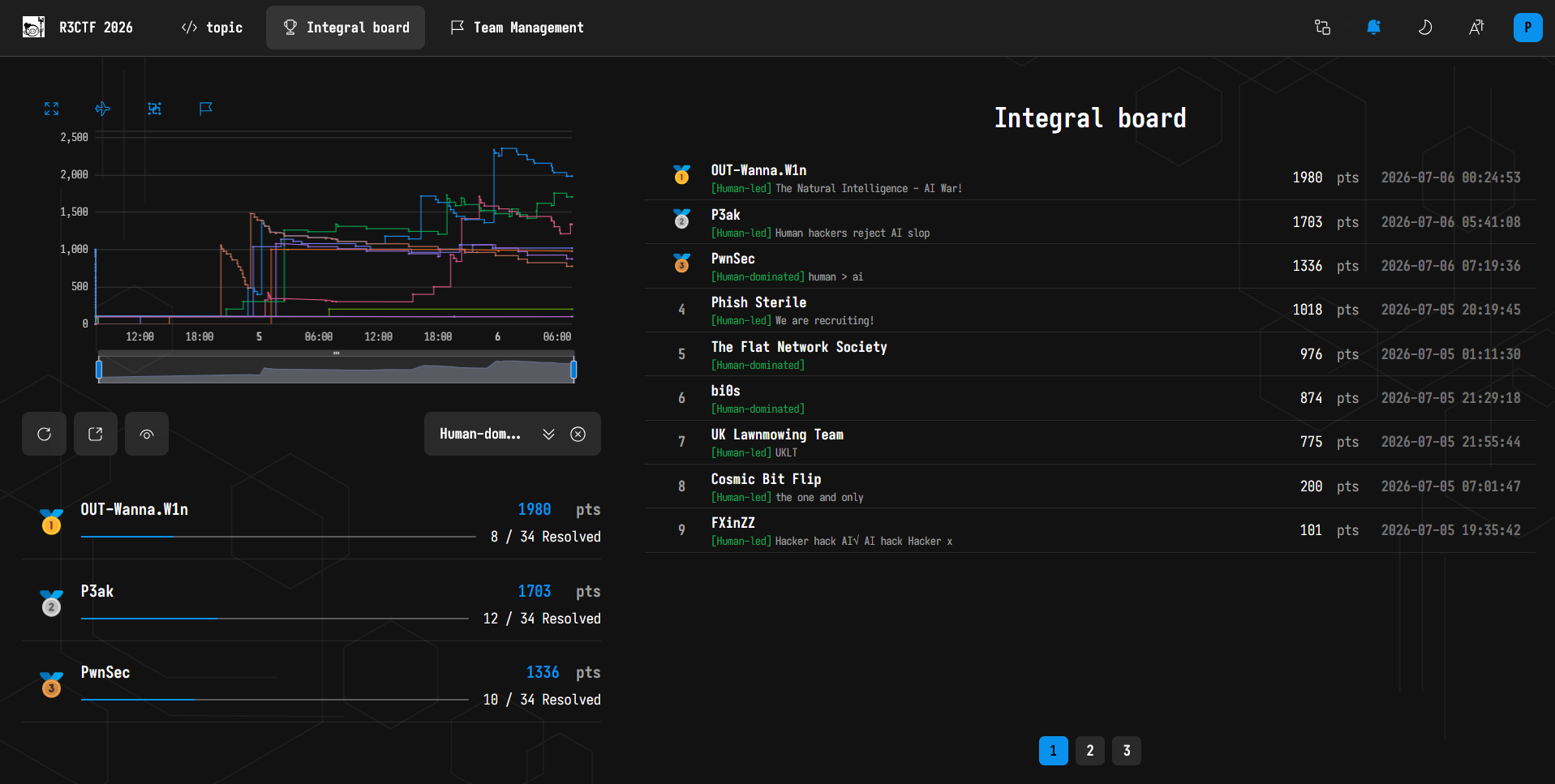
we placed 2nd in the human category and 21st overall !!
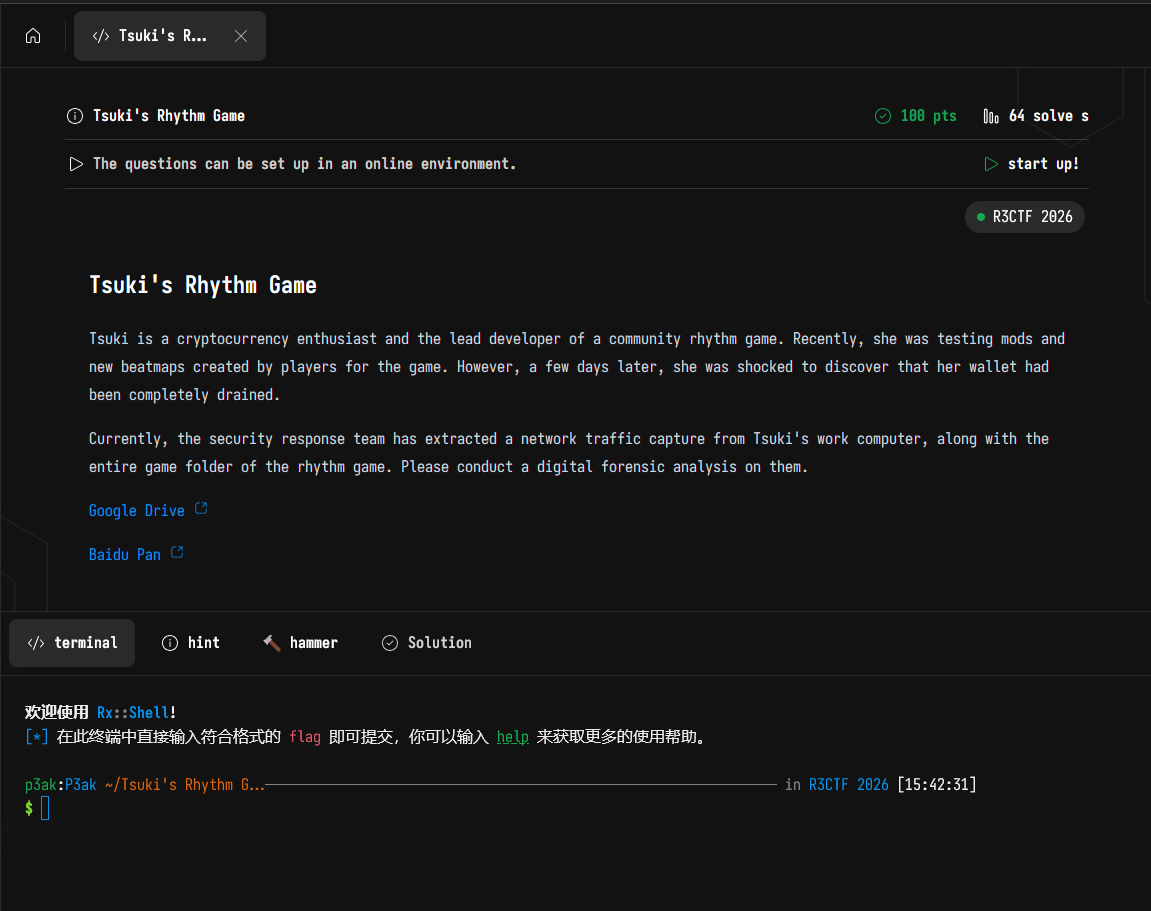
Challenge Description
Tsuki is a cryptocurrency enthusiast and the lead developer of a community rhythm game. Recently, she was testing mods and new beatmaps created by players for the game. However, a few days later, she was shocked to discover that her wallet had been completely drained.
Currently, the security response team has extracted a network traffic capture from Tsuki's work computer, along with the entire game folder of the rhythm game. Please conduct a digital forensic analysis on them.
Given Files
The handout contains 3 files:
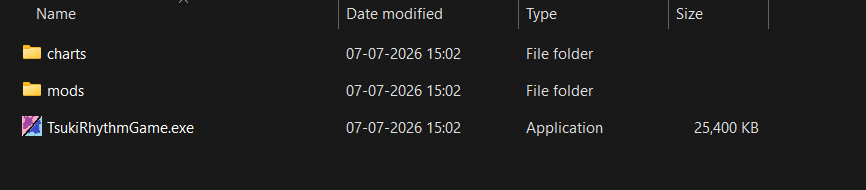
Evidence.zip- password protectedGame.zip- the rhythm game foldertraffic.pcapng- network capture from Tsuki's machine
Extracting Game.zip has 3 more files in it mhm
Question 1 - MD5 hash of the main executable
Answer: 1eeb9c6ed21903f22e1b28dbcbc5c01c
Solution
lets start by opening traffic.pcapng in Wireshark,and filter it with to see the downloads :
http.request.uri contains ".exe"And 2 exe downloads are visible - TsukiRhythmGame.exe (26 MB from 192.168.117.1:3000) and Updater.exe (268 KB from 192.168.117.1:8000).
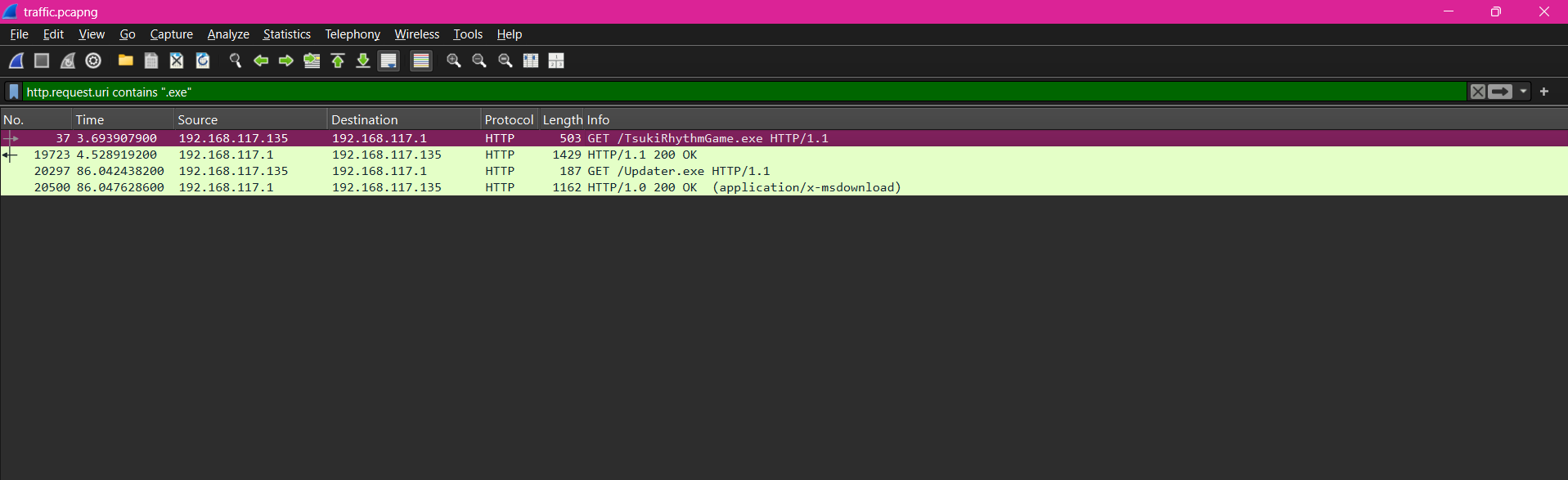
Lets export this for reversing ; Go to File - Export Objects - HTTP, select TsukiRhythmGame.exe and save it.
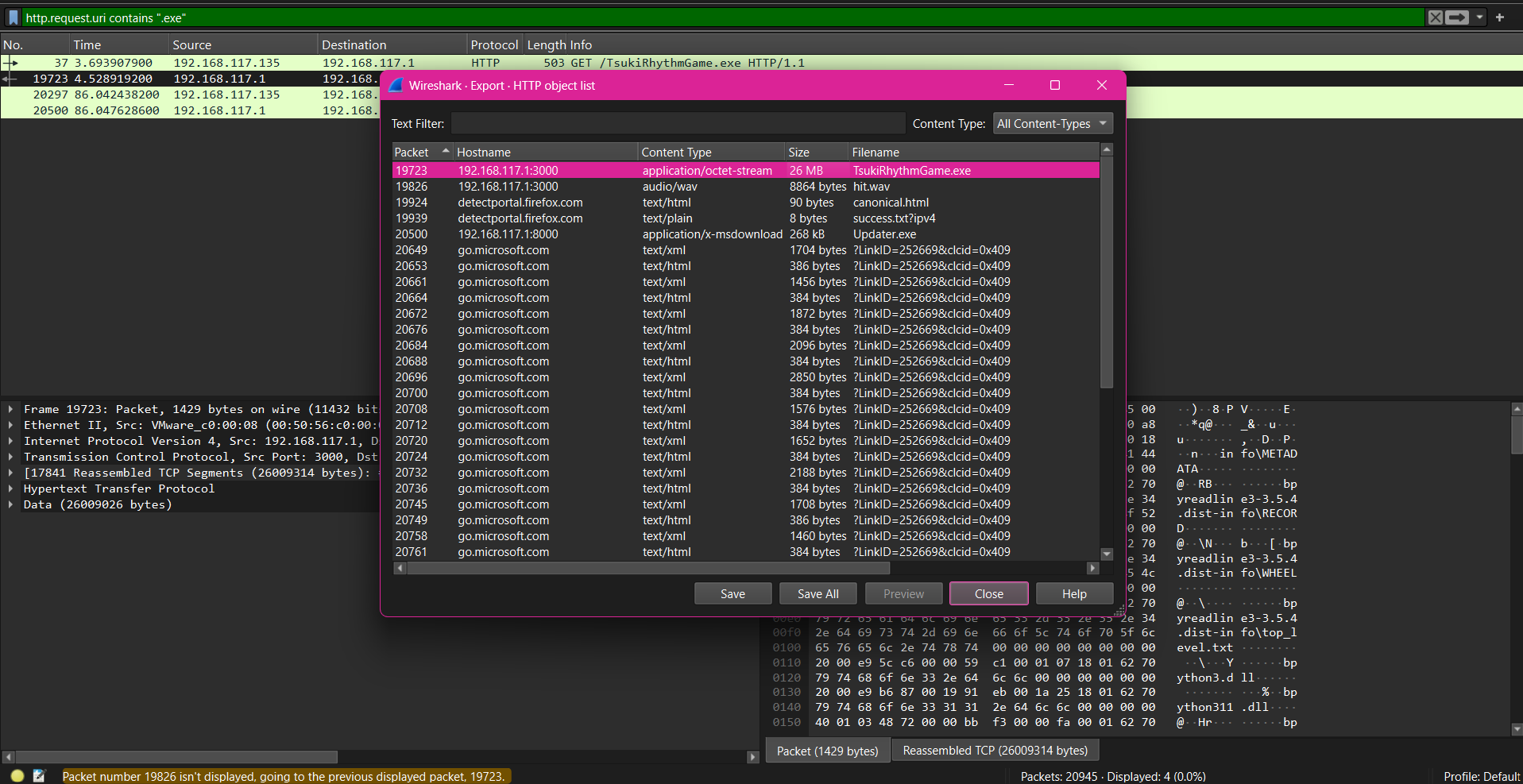
and Verify the hash:
certutil -hashfile TsukiRhythmGame.exe MD5Output confirms: 1eeb9c6ed21903f22e1b28dbcbc5c01c
Question 2 - AES Key and IV used to encrypt/decrypt beatmaps
Answer: TsukiRhythmKey!!_TsukiRhythmIV!!!
Solution
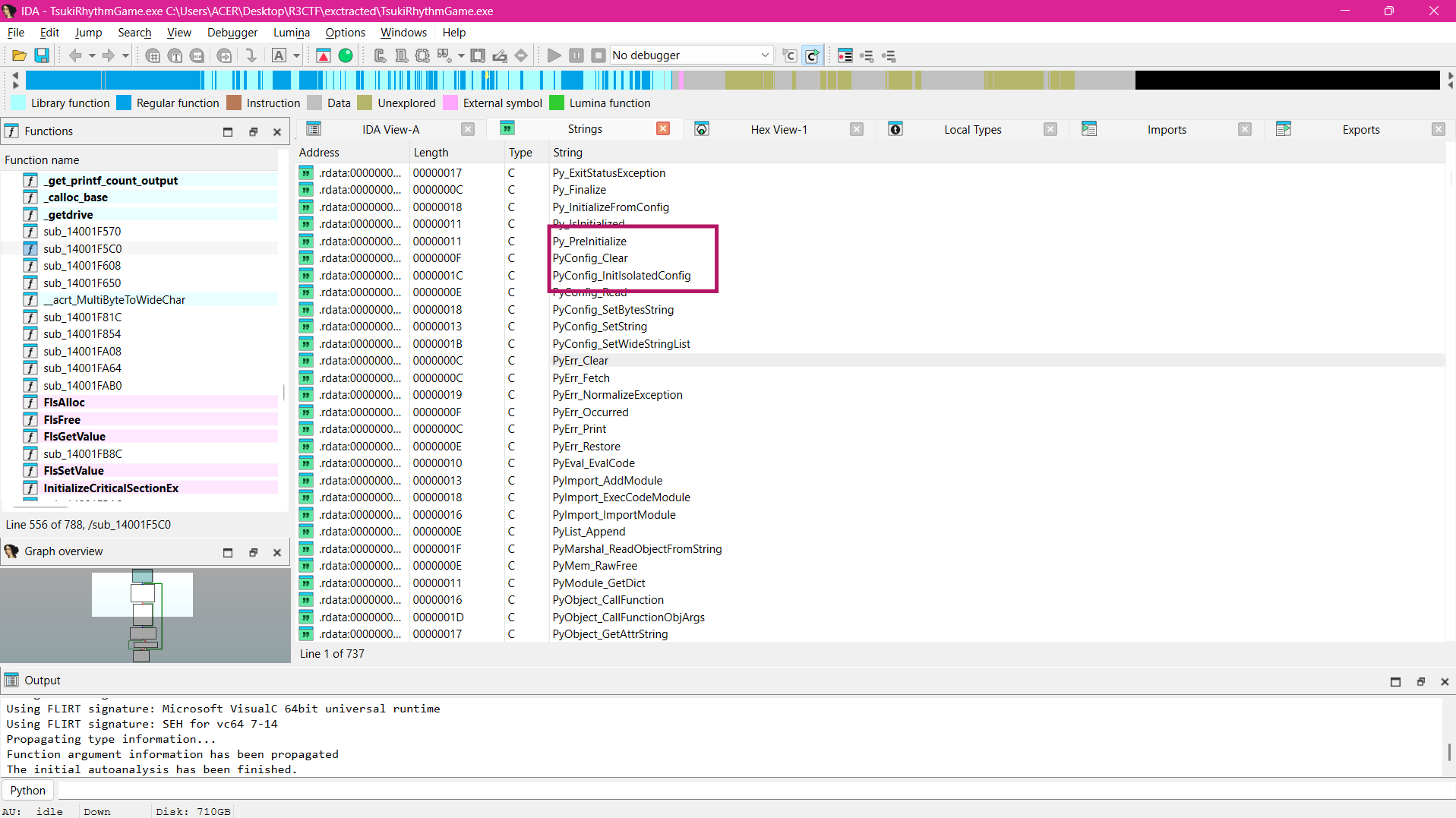
Opening TsukiRhythmGame.exe in IDA shows Python API strings (Py_PreInitialize, PyConfig_Clear, etc.), so the binary is a PyInstaller-packed Python application and we'll need to unpack it using pyextrator.
Extract the bundled .pyc files using pyinstxtractor-ng:
python -m pyinstxtractor_ng "C:\Users\ACER\Desktop\R3CTF\Game\TsukiRhythmGame.exe"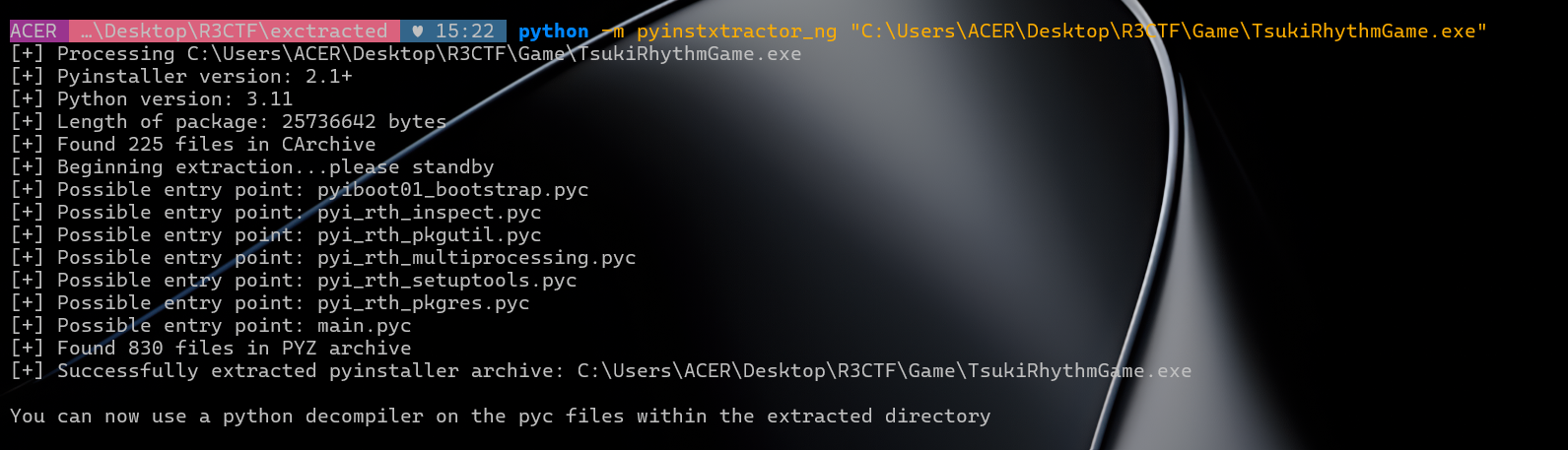
there are many ways to decompile but just use the web interface for pylingual , upload main.pyc (Python 3.11) to pylingual.io to decompile it. Lines 23-24 have the hardcoded AES constants:
AES_KEY = b'TsukiRhythmKey!!'
AES_IV = b'TsukiRhythmIV!!!'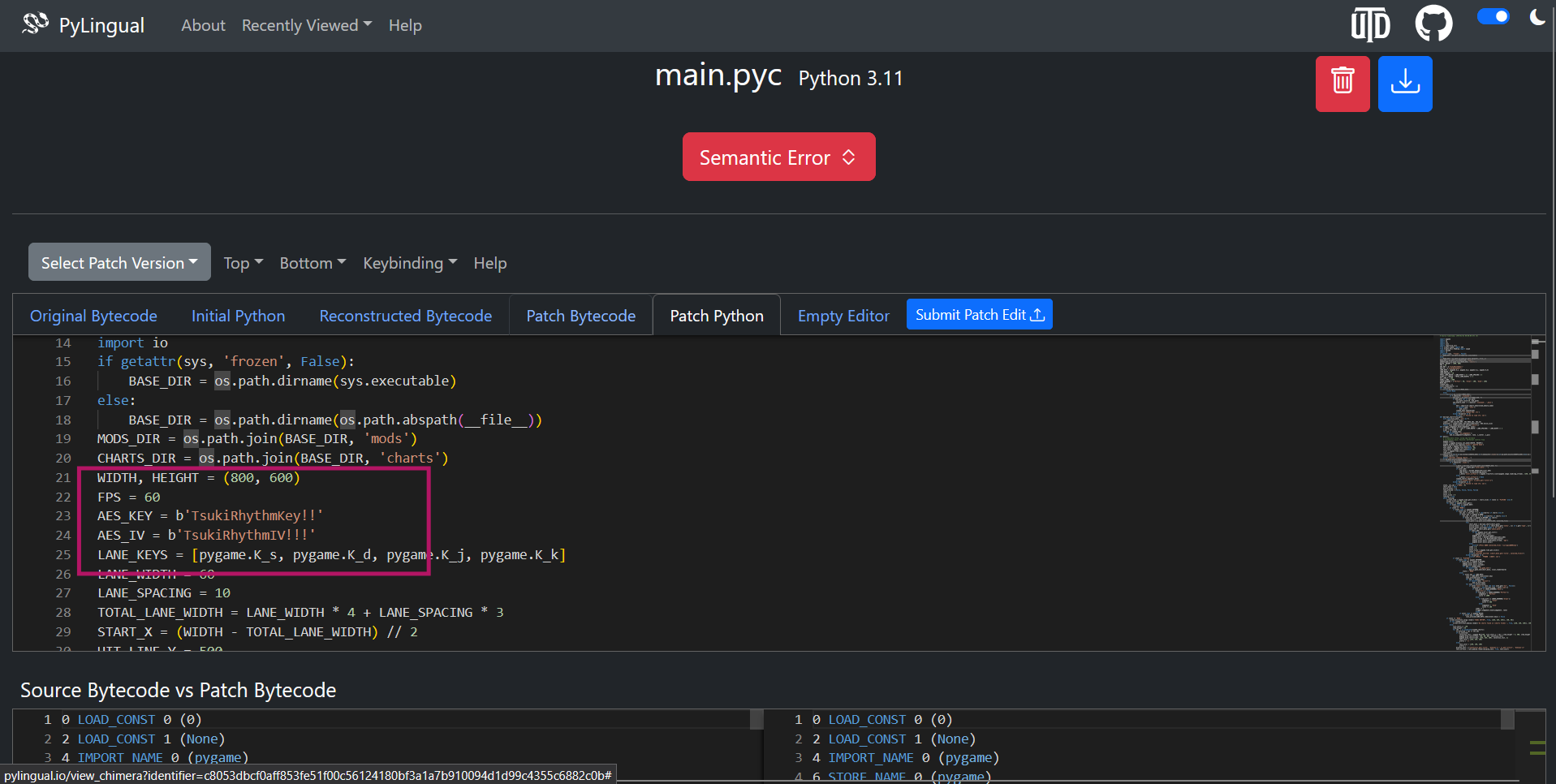
Full decompiled main.py
# Decompiled with PyLingual (https://pylingual.io)
# Internal filename: 'main.py'
# Bytecode version: 3.11a7e (3495)
# Source timestamp: 1970-01-01 00:00:00 UTC (0)

import pygame
import os
import sys
import json
import importlib.util
from Crypto.Cipher import AES
from Crypto.Util.Padding import unpad
import base64
import io
if getattr(sys, 'frozen', False):
    BASE_DIR = os.path.dirname(sys.executable)
else:
    BASE_DIR = os.path.dirname(os.path.abspath(__file__))
MODS_DIR = os.path.join(BASE_DIR, 'mods')
CHARTS_DIR = os.path.join(BASE_DIR, 'charts')
WIDTH, HEIGHT = (800, 600)
FPS = 60
AES_KEY = b'TsukiRhythmKey!!'
AES_IV = b'TsukiRhythmIV!!!'
LANE_KEYS = [pygame.K_s, pygame.K_d, pygame.K_j, pygame.K_k]
LANE_WIDTH = 60
LANE_SPACING = 10
TOTAL_LANE_WIDTH = LANE_WIDTH * 4 + LANE_SPACING * 3
START_X = (WIDTH - TOTAL_LANE_WIDTH) // 2
HIT_LINE_Y = 500
SCROLL_TIME = 1500
JUDGE_WINDOWS = {'Perfect': 50, 'Great': 100, 'Good': 150}
BASE_DIR = ''
loaded_mods = []
local_leaderboard = []
def load_mods():
    if not os.path.exists(MODS_DIR):
        return None
    else:
        for f in os.listdir(MODS_DIR):
            if f.endswith('.tsukimod'):
                mod_path = os.path.join(MODS_DIR, f)
                if mod_path not in sys.path:
                    sys.path.insert(0, mod_path)
                mod_module_name = f.replace('.tsukimod', '_main')
                try:
                    mod = importlib.import_module(mod_module_name)
                    if hasattr(mod, 'init'):
                        mod.init()
                    loaded_mods.append(mod)
                    print(f'[+] Loaded Mod: {f}')
                except Exception as e:
                    print(f'[-] Failed to load {f}: {e}')
def decrypt_chart(file_path):
    with open(file_path, 'rb') as f:
        ciphertext = f.read()
    cipher = AES.new(AES_KEY, AES.MODE_CBC, AES_IV)
    plaintext = unpad(cipher.decrypt(ciphertext), AES.block_size)
    return json.loads(plaintext.decode('utf-8'))
def trigger_judgement_hook(judgement, lane):
    x_center = START_X + lane * (LANE_WIDTH + LANE_SPACING) + LANE_WIDTH // 2
    y_pos = HIT_LINE_Y - 20
    for mod in loaded_mods:
        if hasattr(mod, 'on_judgement'):
            mod.on_judgement(judgement, lane, x_center, y_pos)
def main():
    # irreducible cflow, using cdg fallback
    # ***<module>.main: Failure: Different control flow
    pygame.init()
    screen = pygame.display.set_mode((WIDTH, HEIGHT))
    pygame.display.set_caption('Tsuki\'s Rhythm Game')
    font_large = pygame.font.Font(None, 48)
    font_medium = pygame.font.Font(None, 36)
    font_small = pygame.font.Font(None, 24)
    clock = pygame.time.Clock()
    load_mods()
    charts = [f for f in os.listdir(CHARTS_DIR) if f.endswith('.tsuki')] if os.path.exists(CHARTS_DIR) else []
    loaded_charts = []
    print('[System] Loading charts...')
    if os.path.exists(CHARTS_DIR):
        for f in os.listdir(CHARTS_DIR):
            if f.endswith('.tsuki'):
                try:
                    c_data = decrypt_chart(os.path.join(CHARTS_DIR, f))
                    cover_b64 = c_data.get('cover_data', '')
                    if cover_b64:
                        img_bytes = base64.b64decode(cover_b64)
                        img_stream = io.BytesIO(img_bytes)
                        c_data['cover_surface'] = pygame.transform.scale(pygame.image.load(img_stream), (250, 250))
                    else:
                        c_data['cover_surface'] = None
                    loaded_charts.append(c_data)
                    print(f"Loaded chart: {c_data.get('title')}")
                except Exception as e:
                    print(f'[-] Failed to load {f}: {e}')
    state, sel_idx = ('MENU', 0)
    chart_data = None
    active_notes = []
    lane_pressed = [False, False, False, False]
    combo = 0
    score = 0
    start_ticks = 0
    running = True
    while running:
        current_time = pygame.time.get_ticks() - start_ticks if state == 'PLAYING' else 0
        screen.fill((20, 20, 20))
        for event in pygame.event.get():
            if event.type == pygame.QUIT:
                running = False
            if state == 'MENU':
                if event.type == pygame.KEYDOWN:
                    if event.key == pygame.K_UP:
                        sel_idx = (sel_idx - 1) % len(charts) if charts else 0
                        if event.key == pygame.K_DOWN:
                            sel_idx = (sel_idx + 1) % len(charts) if charts else 0
                            if event.key == pygame.K_RETURN and charts:
                                selected_file = charts[sel_idx]
                                chart_path = os.path.join(CHARTS_DIR, selected_file)
                                try:
                                    chart_data = decrypt_chart(chart_path)
                                    active_notes = [n for n in chart_data.get('notes', []) if n.get('type', 1)!= 99]
                                    active_notes.sort(key=lambda x: x['time'])
                                    audio_b64 = chart_data.get('audio_data')
                                    if audio_b64:
                                        if not pygame.mixer.get_init():
                                            pygame.mixer.init()
                                        pygame.mixer.music.unload()
                                        audio_bytes = base64.b64decode(audio_b64)
                                        audio_stream = io.BytesIO(audio_bytes)
                                        pygame.mixer.music.load(audio_stream, 'mp3')
                                        pygame.mixer.music.play()
                                    else:
                                        print(f'[警-] 谱面 {selected_file} 中-----? 据!')
                                    combo = 0
                                    score = 0
                                    start_ticks = pygame.time.get_ticks()
                                    state = 'PLAYING'
                                    print(f"[System] Started: {chart_data.get('title', selected_file)}")
                                except Exception as e:
                                    print(f'[-误] - ?谱面-载失败: {e}')
                if state == 'PLAYING':
                    if event.type == pygame.KEYDOWN:
                        if event.key == pygame.K_ESCAPE:
                            pygame.mixer.music.stop()
                            pygame.mixer.music.unload()
                            for mod in loaded_mods:
                                if hasattr(mod, 'on_game_end'):
                                    mod.on_game_end(chart_data, local_leaderboard)
                            state = 'MENU'
                        else:
                            if event.key in LANE_KEYS:
                                lane = LANE_KEYS.index(event.key)
                                lane_pressed[lane] = True
                                for mod in loaded_mods:
                                    if hasattr(mod, 'on_hit'):
                                        mod.on_hit(lane)
                                for note in active_notes:
                                    if note['lane'] == lane and (not note.get('hit', False)):
                                        time_diff = abs(current_time - note['time'])
                                        if time_diff <= JUDGE_WINDOWS['Good']:
                                            note['hit'] = True
                                            if time_diff <= JUDGE_WINDOWS['Perfect']:
                                                judgement = 'Perfect'
                                                score += 1000
                                            else:
                                                if time_diff <= JUDGE_WINDOWS['Great']:
                                                    judgement = 'Great'
                                                    score += 500
                                                else:
                                                    judgement = 'Good'
                                                    score += 100
                                            combo += 1
                                            trigger_judgement_hook(judgement, lane)
                                            break
                        if event.type == pygame.KEYUP:
                            if event.key in LANE_KEYS:
                                lane_pressed[LANE_KEYS.index(event.key)] = False
        if state == 'MENU':
            screen.blit(font_large.render('TSUKI RHYTHM', True, (255, 255, 255)), (50, 50))
            if not loaded_charts:
                screen.blit(font_medium.render('No charts found in /charts folder.', True, (150, 150, 150)), (50, 150))
            else:
                list_start_y = 150
                item_height = 45
                for idx, c in enumerate(loaded_charts):
                    is_selected = idx == sel_idx
                    if is_selected:
                        selection_rect = pygame.Rect(40, list_start_y + idx * item_height - 5, 400, item_height - 5)
                        pygame.draw.rect(screen, (60, 60, 80), selection_rect)
                        pygame.draw.rect(screen, (255, 255, 100), selection_rect, 2)
                        text_color = (255, 255, 100)
                        prefix = '>> '
                    else:
                        text_color = (150, 150, 150)
                        prefix = '   '
                    display_text = f"{prefix}{c.get('title', 'Unknown')} - {c.get('artist', 'Unknown')}"
                    text_surface = font_medium.render(display_text, True, text_color)
                    screen.blit(text_surface, (50, list_start_y + idx * item_height))
                current_c = loaded_charts[sel_idx]
                preview_x = WIDTH - 300
                preview_y = 150
                if current_c.get('cover_surface'):
                    screen.blit(current_c['cover_surface'], (preview_x, preview_y))
                    pygame.draw.rect(screen, (255, 255, 255), (preview_x, preview_y, 250, 250), 3)
                else:
                    pygame.draw.rect(screen, (40, 40, 40), (preview_x, preview_y, 250, 250))
                    screen.blit(font_small.render('NO PREVIEW', True, (100, 100, 100)), (preview_x + 80, preview_y + 110))
                detail_y = preview_y + 270
                title_txt = font_small.render(f"Title: {current_c.get('title')}", True, (255, 255, 255))
                artist_txt = font_small.render(f"Artist: {current_c.get('artist')}", True, (200, 200, 200))
                screen.blit(title_txt, (preview_x, detail_y))
                screen.blit(artist_txt, (preview_x, detail_y + 25))
        else:
            if state == 'PLAYING':
                for i in range(4):
                    x = START_X + i * (LANE_WIDTH + LANE_SPACING)
                    color = (50, 50, 50) if not lane_pressed[i] else (120, 120, 120)
                    pygame.draw.rect(screen, color, (x, 0, LANE_WIDTH, HEIGHT))
                    key_color = (200, 200, 200) if not lane_pressed[i] else (255, 255, 255)
                    pygame.draw.rect(screen, key_color, (x, HIT_LINE_Y, LANE_WIDTH, 20))
                    key_char = font_medium.render(pygame.key.name(LANE_KEYS[i]).upper(), True, (0, 0, 0))
                    screen.blit(key_char, (x + 20, HIT_LINE_Y - 2))
                pygame.draw.line(screen, (255, 255, 255), (START_X, HIT_LINE_Y), (START_X + TOTAL_LANE_WIDTH - LANE_SPACING, HIT_LINE_Y), 3)
                all_processed = True
                for note in active_notes:
                    if note.get('hit', False):
                        continue
                    all_processed = False
                    time_diff = current_time - note['time']
                    if time_diff > JUDGE_WINDOWS['Good']:
                        note['hit'] = True
                        combo = 0
                        trigger_judgement_hook('Miss', note['lane'])
                        continue
                    time_to_hit = note['time'] - current_time
                    y_pos = HIT_LINE_Y - time_to_hit * (HIT_LINE_Y / SCROLL_TIME)
                    if (-50) < y_pos < HEIGHT:
                            x_pos = START_X + note['lane'] * (LANE_WIDTH + LANE_SPACING)
                            pygame.draw.rect(screen, (255, 255, 255), (x_pos, int(y_pos) - 10, LANE_WIDTH, 20))
                for mod in loaded_mods:
                    if hasattr(mod, 'on_render'):
                        mod.on_render(screen)
                screen.blit(font_medium.render(f'Combo: {combo}', True, (255, 255, 255)), (20, 20))
                screen.blit(font_medium.render(f'Score: {score}', True, (255, 255, 255)), (20, 60))
                screen.blit(font_small.render('Press ESC to exit', True, (150, 150, 150)), (20, HEIGHT - 40))
                if all_processed and len(active_notes) > 0 and (current_time > active_notes[(-1)]['time'] + 2000):
                            pygame.mixer.music.stop()
                            pygame.mixer.music.unload()
                            for mod in loaded_mods:
                                if hasattr(mod, 'on_game_end'):
                                    mod.on_game_end(chart_data, local_leaderboard)
                            state = 'MENU'
        pygame.display.flip()
        clock.tick(FPS)
    pygame.quit()
if __name__ == '__main__':
    main()
Question 3 - MD5 hash of the malicious payload bytecode
Answer: aed1e4e8b9061e19506848ca579e46ac
Solution
back to the decompiled main.py, after reading it , this line :
active_notes = [n for n in chart_data.get('notes', []) if n.get('type', 1) != 99]Type-99 notes are silently filtered out before the game renders anything. So they never appear on screen and we the player never sees them.SUS?
Decrypting Eggdrasil.tsuki and pulling all type-99 notes revealed 3096 of them, all with time: 0.having - just lane values (0-3). Two bits each seems so far to be a bitstream.
We can try reconstructing the payload by reading lane values as 2-bit chunks in order:
from Crypto.Cipher import AES
from Crypto.Util.Padding import unpad
import json, hashlib

KEY = b'TsukiRhythmKey!!'
IV  = b'TsukiRhythmIV!!!'

with open('Eggdrasil.tsuki', 'rb') as f:
    ct = f.read()

cipher = AES.new(KEY, AES.MODE_CBC, IV)
pt = unpad(cipher.decrypt(ct), AES.block_size)
data = json.loads(pt.decode('utf-8'))

notes99 = [n for n in data.get('notes', []) if n.get('type') == 99]

bits = ''.join(format(n['lane'], '02b') for n in notes99)
payload = bytes(int(bits[i:i+8], 2) for i in range(0, len(bits)//8*8, 8))

print(hashlib.md5(payload).hexdigest())
soo the attacker hid an executable Python payload inside fake rhythm game notes.
MD5 confirms: aed1e4e8b9061e19506848ca579e46ac
Question 4 - C2 server listening port
Answer: 4444
Solution
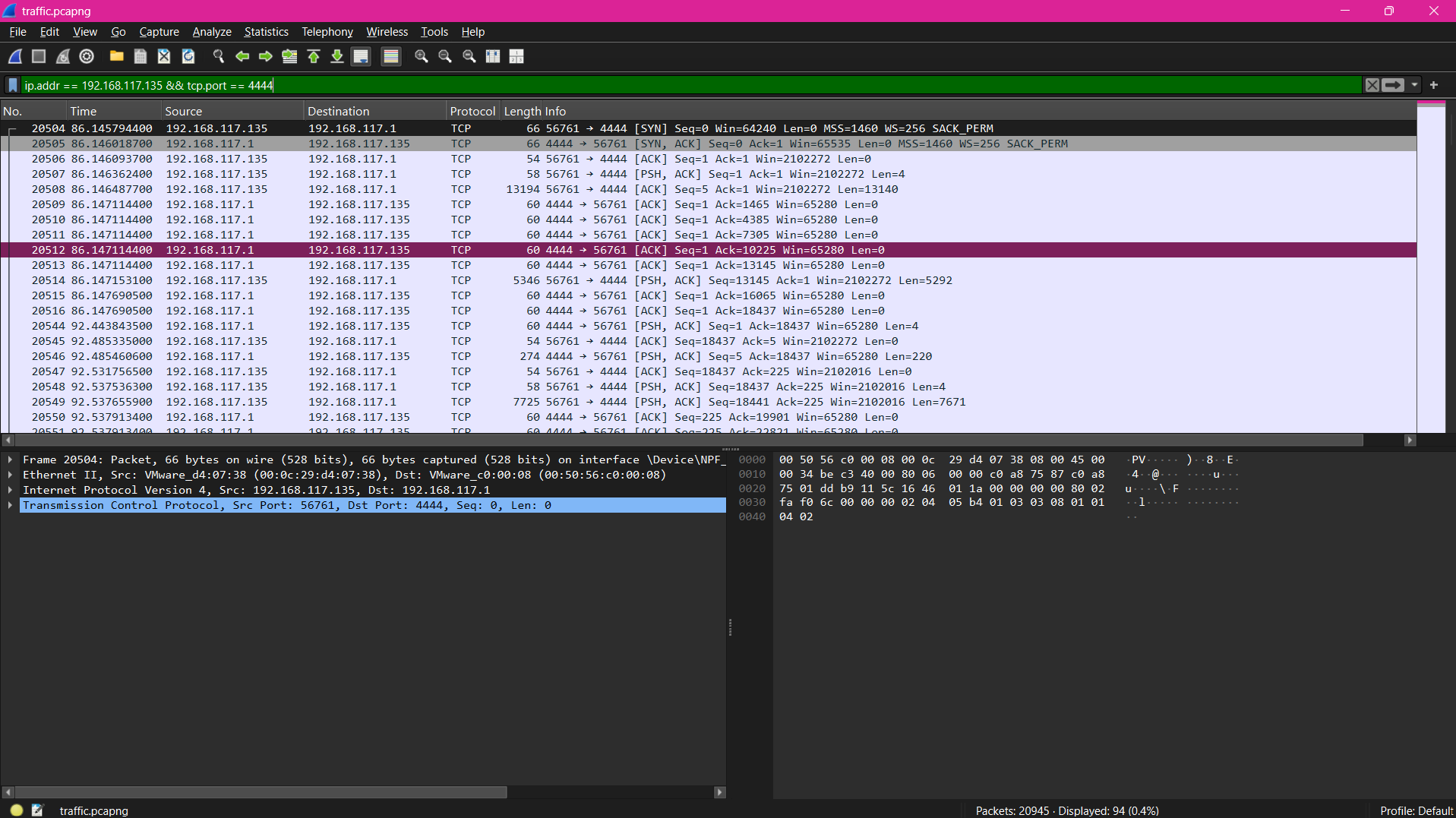
The payload bytecode downloads Updater.exe from 192.168.117.1:8000 and executes it. Looking at traffic.pcapng, there's a TCP conversation from the victim back to 192.168.117.1:4444 the reverse shell port.also that should be the C2 server and we can look more into this with better fildtering .
Sorting the TCP conversations by Port B in Wireshark well.. shows - 192.168.117.135 connecting back to 192.168.117.1:4444, 94 packets, 93 KB, lasting 66 seconds. Starts right after Updater.exe was downloaded.
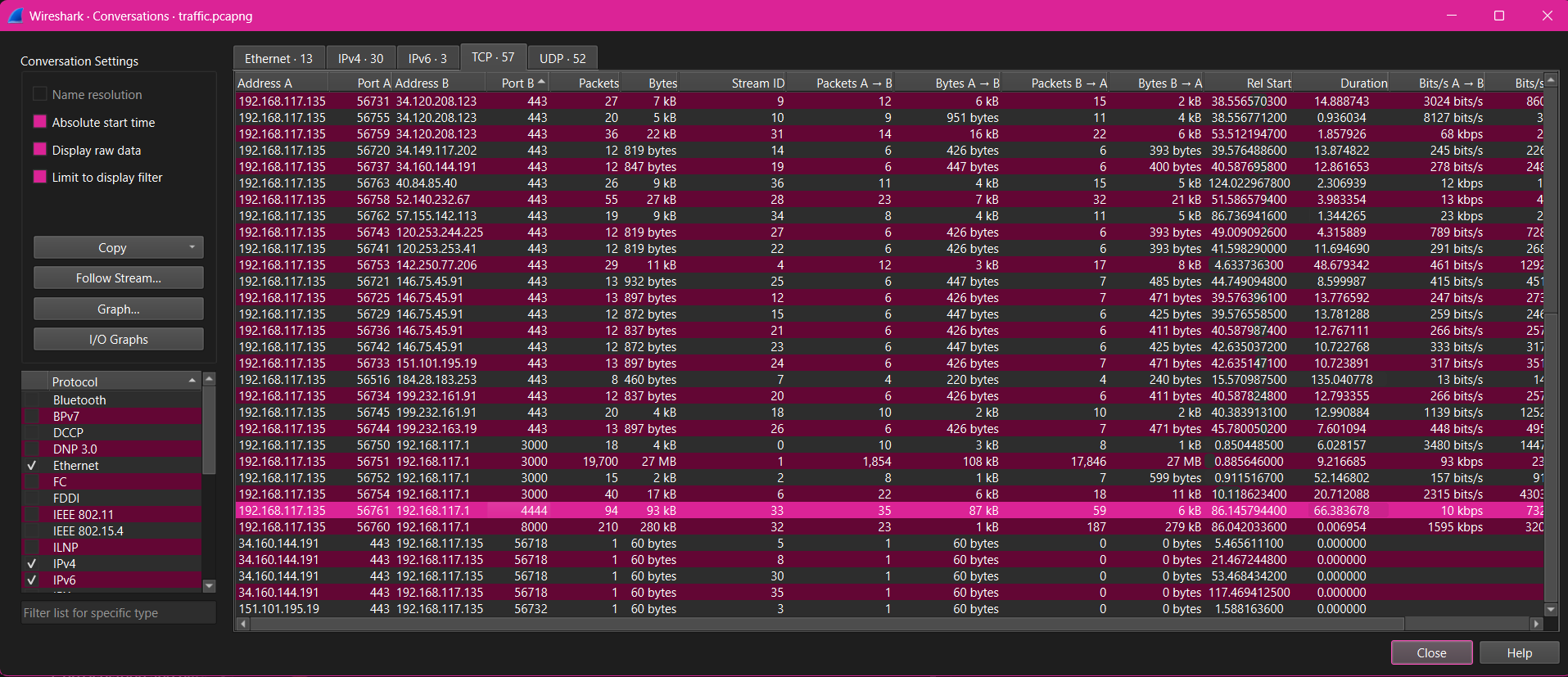
Port 4444 confirmed.
Question 5 - Local file read by Updater.exe for encryption key material
Answer: C:\Windows\hh.exe
Solution
I opened Updater.exe in IDA Pro and let the autoanalysis finish. The binary imports BCryptOpenAlgorithmProvider, BCryptGenerateSymmetricKey, BCryptEncrypt, and BCryptDecrypt from bcrypt.dll, so AES encryption is happening somewhere. It also imports connect, send, and recv from WS2_32 * for the reverse shell plumbing.
Interestingly, CreateFileW and ReadFile only show up in library helper functions.I xrefd the checked main() and found the reson, the binary resolves CreateFileA and ReadFile dynamically at runtime via GetProcAddress, storing the results in global function pointers.
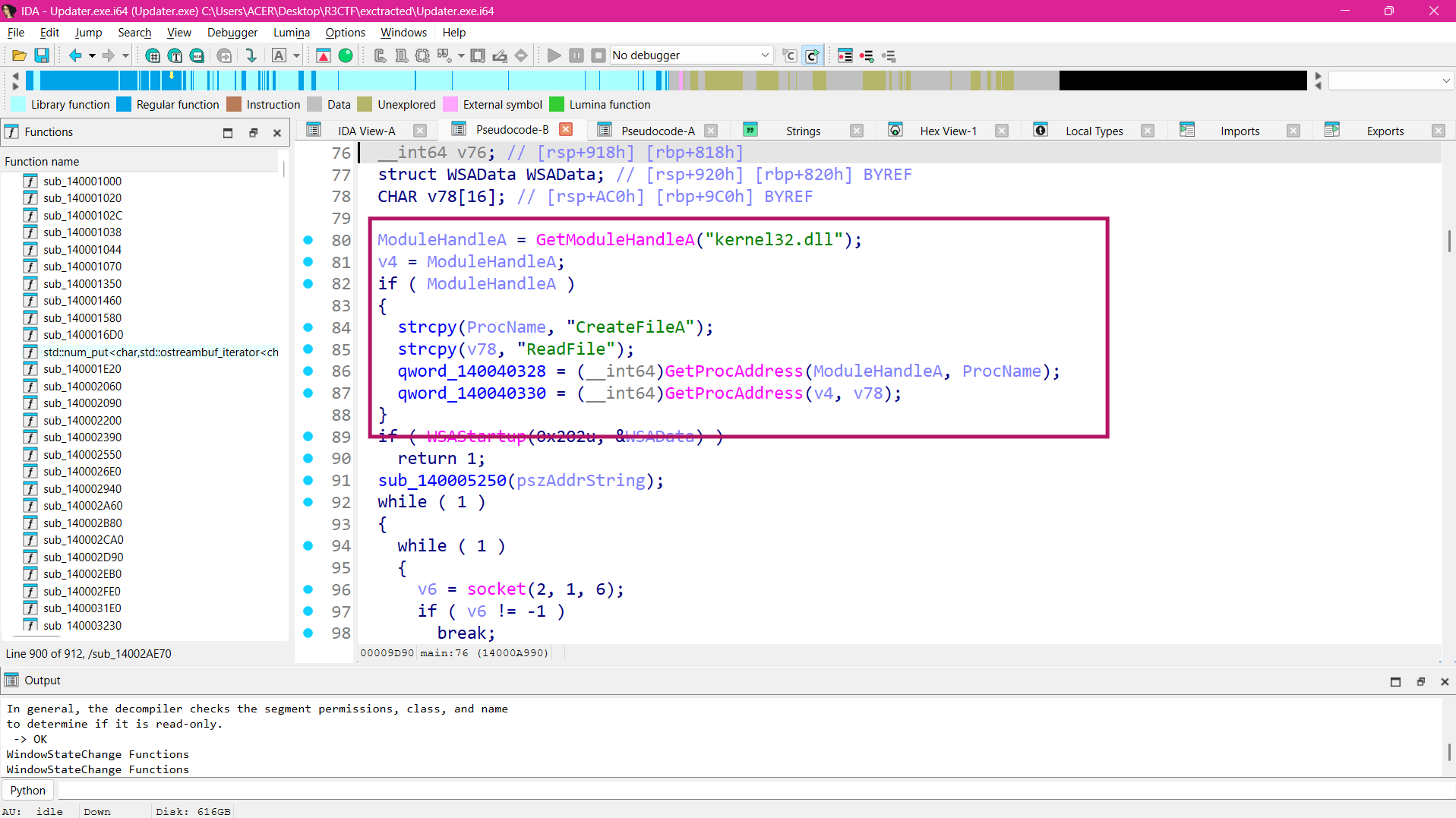
strcpy(ProcName, "CreateFileA");
strcpy(v78, "ReadFile");
qword_140040328 = (__int64)GetProcAddress(ModuleHandleA, ProcName);
qword_140040330 = (__int64)GetProcAddress(v4, v78);
This is so that the file can evade I/O from static import analysis - the imports tab shows nothing, but the binary can still open and read files at runtime.
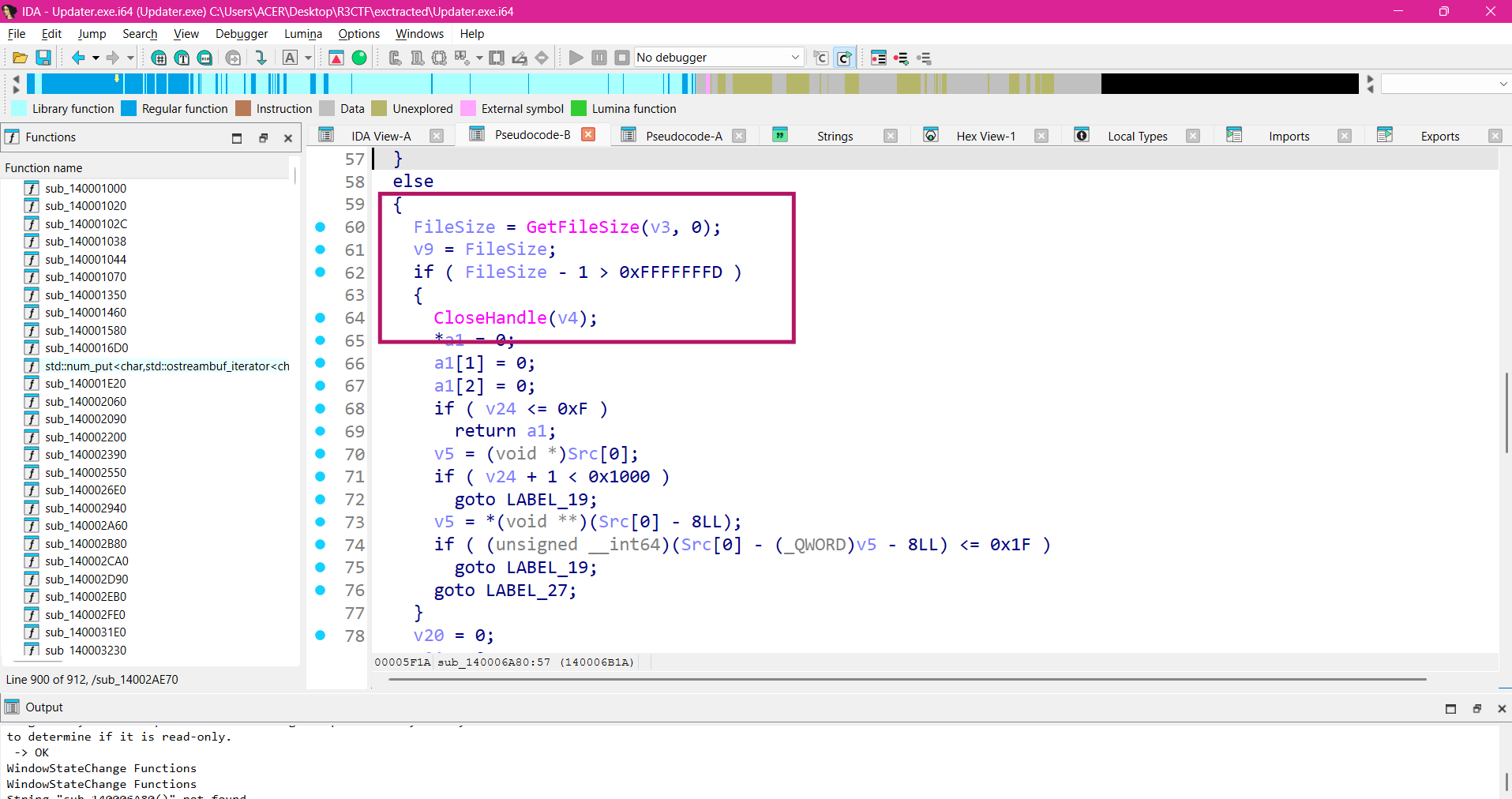
Cross-referencing those two globals (qword_140040328, qword_140040330) led to sub_140006A80, which is called in main() right after the C2 connection is established. Inside, it calls the resolved CreateFileA pointer to open a file, checks the size is for some constraint ig , allocates a buffer, then calls the resolved ReadFile pointer to read the entire contents into memory.
after more reversing file path isn't passed in as a parameter - sub_140006A80 calls another function, sub_1400053B0, to build the path internally. That function constructs a string one character at a time by pushing integer literals onto a std::string. No string constant as well
we can then decoding the byte sequence:
67 58 92 87 105 110 100 111 119 115 92 104 104 46 101 120 101
 C  :  \   W   i   n   d   o   w   s   \   h   h  .   e   x   e
The path is C:\Windows\hh.exe - the Windows HTML Help executable that ships with every Windows install.??
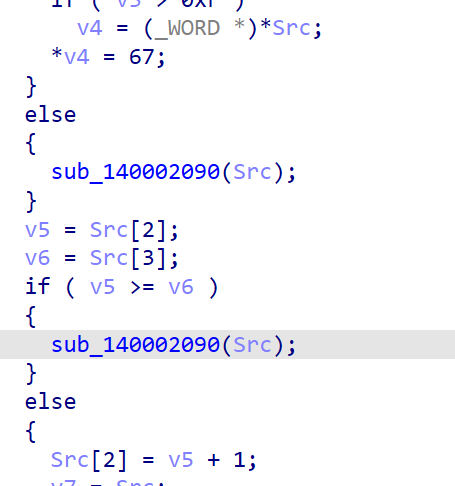
The file contents are then used in main() to build a 256-entry lookup table (v74), which maps each unique byte value found in hh.exe to its first occurrence index. This table is what gets passed into sub_140006300 as the key material for AES decryption of C2 commands.
tldr : Updater.exe reads C:\Windows\hh.exe and uses its byte distribution as an encryption key - this way it can be like a always-present system file acts as a shared secret between implant and server.
Question 6 - Original MD5 hash of the file when read by Updater.exe
Answer: 2c8fe78d53c8ca27523a71dfd2938241
Solution
Since the hh.exe file itself isn't in the handout, we need to recover it from the pcap.
Updater.exe's exfil loop (in main()) is simple:
- Read
hh.exeinto a heap buffer - Prepend a 4-byte big-endian length field
- XOR every byte of the file content with the repeating key
0x1337c0de - Send the whole thing to
192.168.117.1:4444
So the PCAP contains the file, just obfuscated.so ezz and extract the victim-C2 TCP stream:
tshark -r traffic.pcapng \
  -Y "tcp.dstport == 4444 && ip.src == 192.168.117.135 && tcp.len > 0" \
  -T fields -e tcp.payload | tr -d '\n' | xxd -r -p > victim_to_c2.bin
Then decode
import hashlib, struct

with open('victim_to_c2.bin', 'rb') as f:
    raw = f.read()

length = struct.unpack_from('>I', raw, 0)[0]   # 0x4800 = 18432 bytes
key = bytes.fromhex('1337c0de')
decoded = bytes(b ^ key[i % 4] for i, b in enumerate(raw[4:4+length]))

print(decoded[:2])          # b'MZ' - valid PE header, confirms correct decode
print(hashlib.md5(decoded).hexdigest())
Output:
b'MZ'
2c8fe78d53c8ca27523a71dfd2938241
The MZ header at offset 0 confirms we recovered a valid PE file. The 18432-byte blob is the exact hh.exe that was on Tsuki's machine at the time the malware ran.
Question 7 - First command issued by the attacker via C2
Answer: ipconfig /all
Solution
I could have reversed it fully and booted up a VM and checked the readfile the updater.exe used and see what ars it ran but i didnt think of that approach while writing this , my plan was to patch the binary to use the tsuki's hhh.exe and connect to our local C2 server instance set up and see that the malware operated or requests . My initial attepmpts with patching the path resulted in the malware crashing because of an overflow in the expected path length issue and finally i got it under 18 bytes ,with with that out of the way , after sending the XOR'd hh.exe, Updater.exe enters a receive loop. The C2 server sends back 8 encoded command messages, each length-prefixed with a 4-byte big-endian integer and each message body is an ASCII string of dot-separated signed decimal integers - each integer is the first-occurrence index of a byte value in hh.exe. The malware decodes these by looking up each index in a 256-entry table it built from the file, then executes the resulting command string via sub_140006720.
Lets bootup x64dbg dynamic analysis.
Loading and set breakpoints
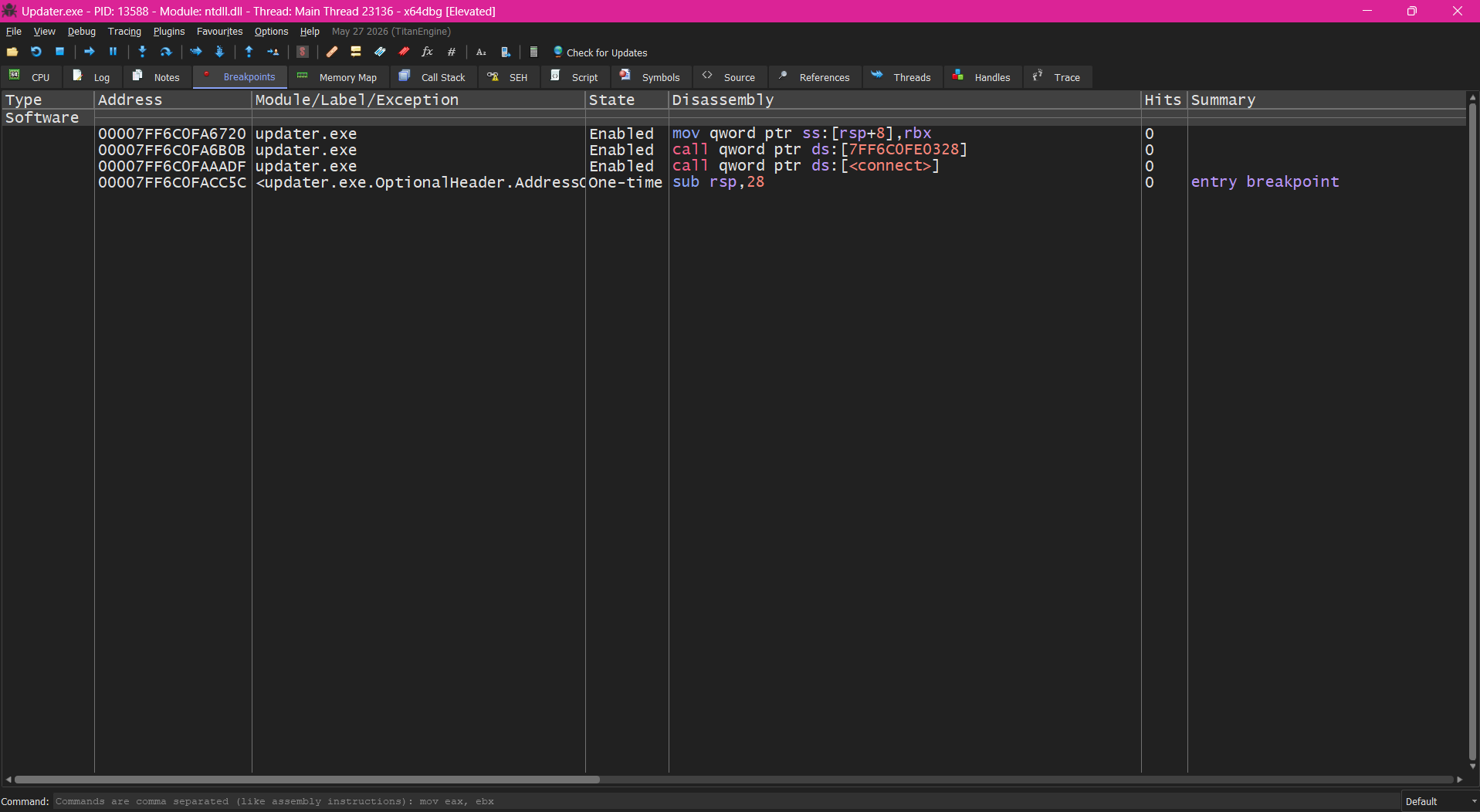
Updater.exe was opened in x64dbg. Three breakpoints were placed:, there is ASLR so the adrssses are random each time
| Address | Purpose |
|---|---|
0x7FF6C0FAAADF |
call [connect] - redirect C2 IP |
0x7FF6C0FA6B0B |
call [CreateFileA] - redirect hh.exe path |
0x7FF6C0FA6720 |
command executor - read decoded command |
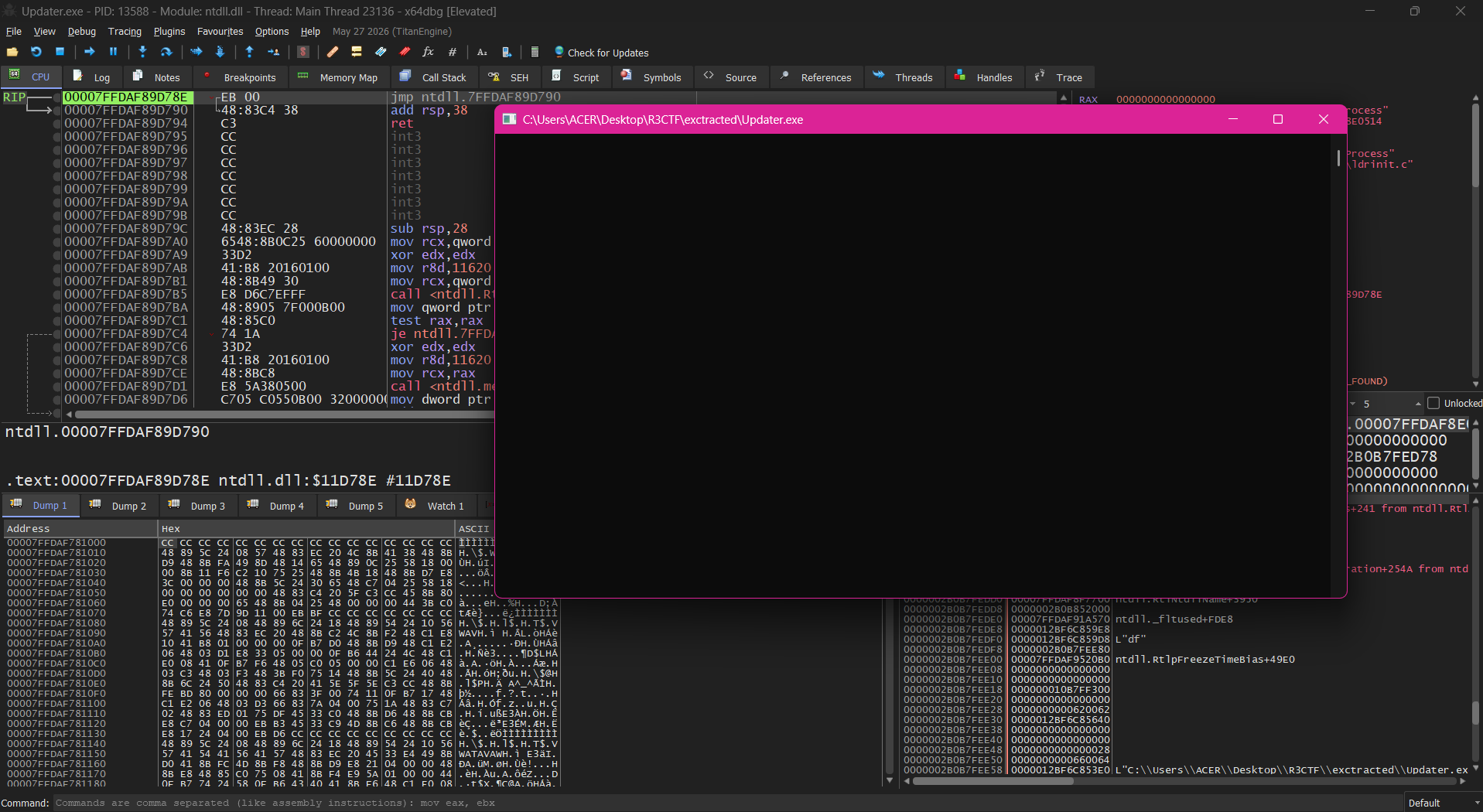
Now lets deploy our fake Replay server
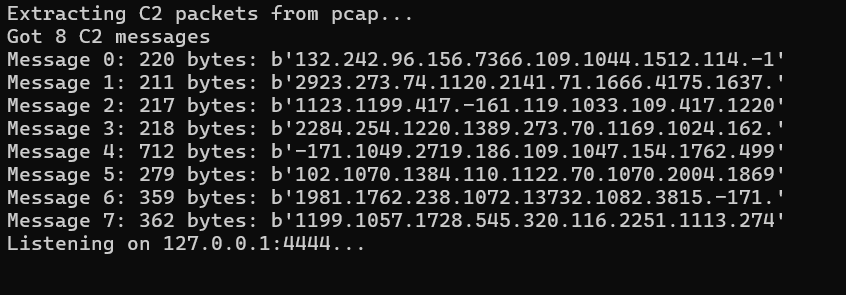
i made it to listen on 127.0.0.1:4444, receive the XOR'd hh.exe upload, verify its MD5, then replay all 8 original C2 messages from the PCAP.
Redirect C2 connection
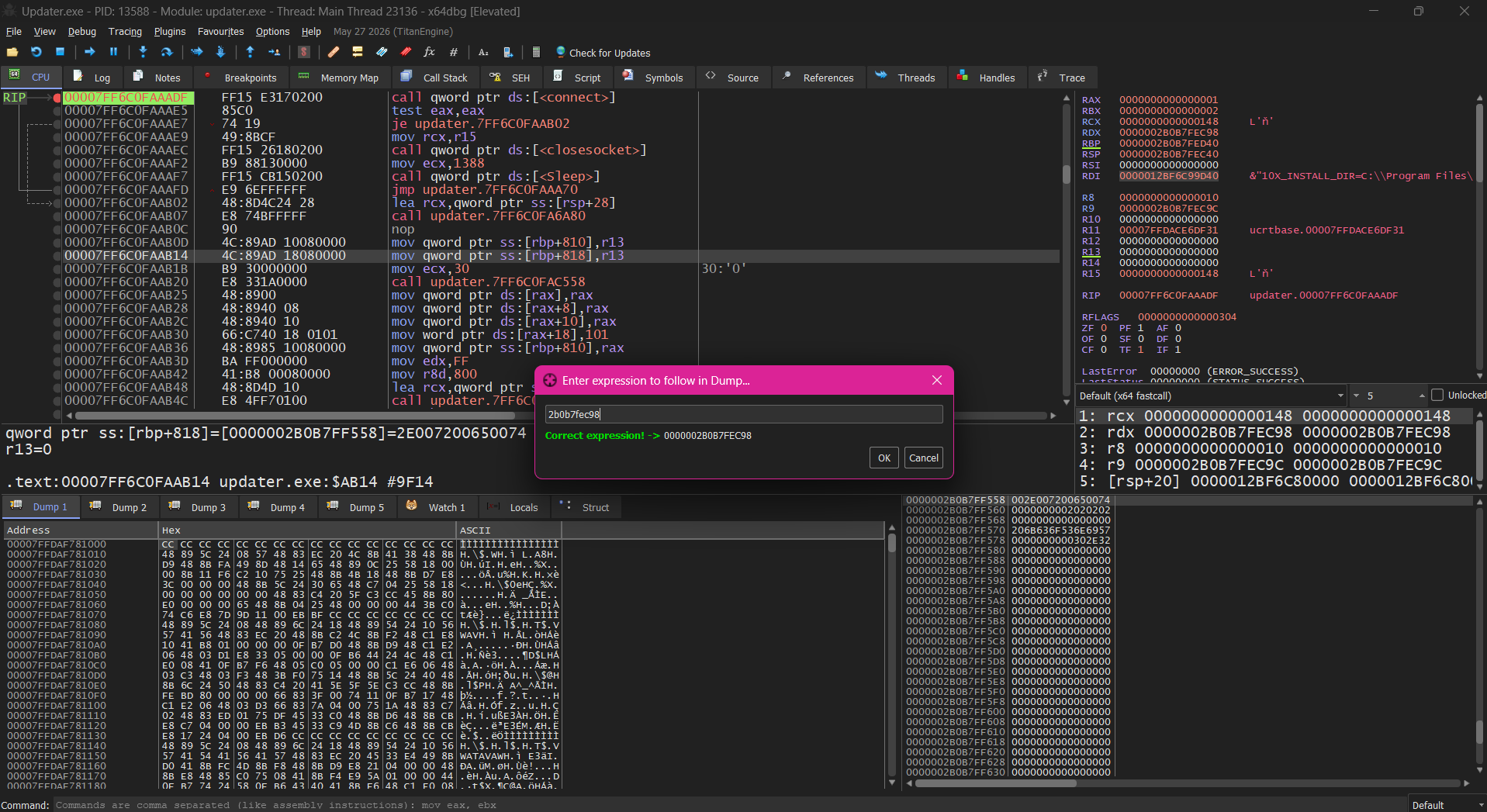
At the connect BP, RDX points to the sockaddr_in struct. The IP field at offset +4 contains c0 a8 75 01 (192.168.117.1 - the real C2). lets overwrite it with 7f 00 00 01 (127.0.0.1) so the malware connects to our replay server instead.
![x64dbg paused at connect BP - call [connect] highlighted, RDX pointing to sockaddr](../ctf-writeups/tsuki-rhythm-game/photos/qsn7-4.png)
pivotning the Redirect hh.exe path
At the CreateFileA BP, RCX contains the heap pointer to the path string C:\Windows\hh.exe. The system's hh.exe (40960 bytes) differs from Tsuki's (18432 bytes), so the lookup table would be wrong. I copied Tsuki's recovered hh.exe to C:\Users\ACER\hh.exe and overwrote the path in memory with the new path bytes (43 3A 5C 55 73 65 72 73 5C 41 43 45 52 5C 68 68 2E 65 78 65 00).
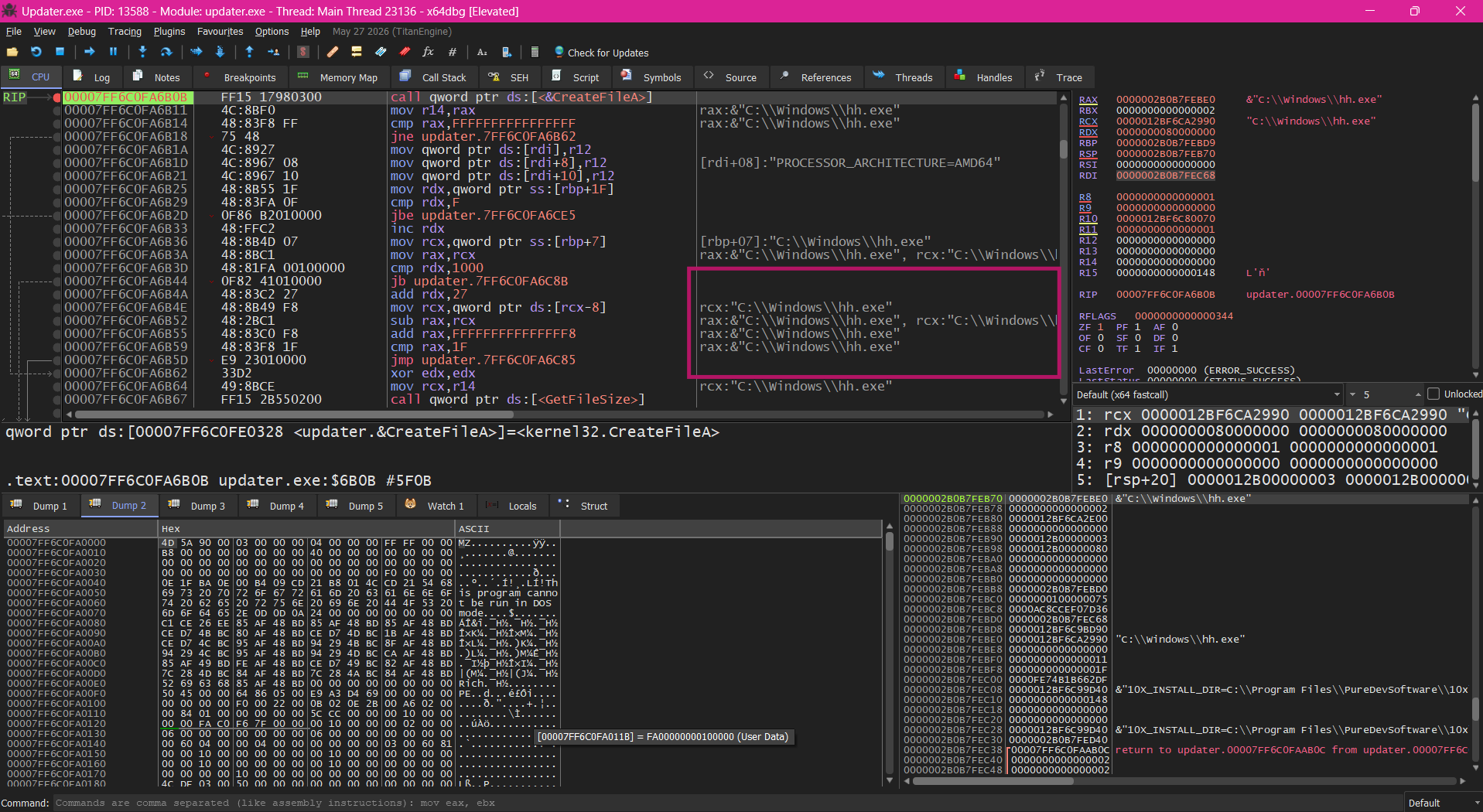
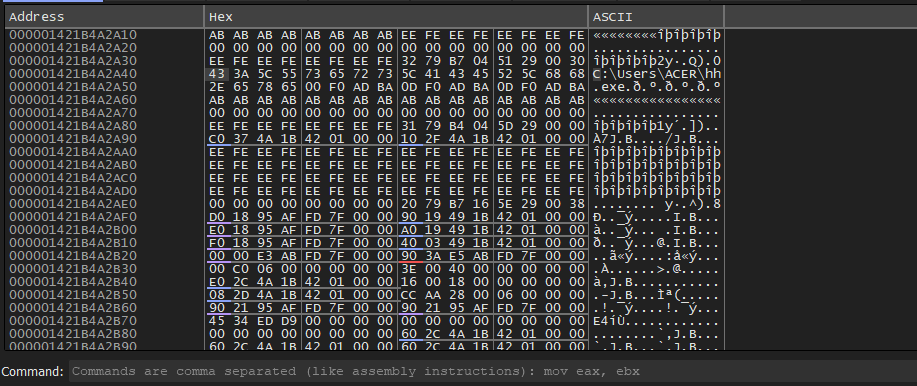
Connection established, hh.exe received :)
After resuming, the malware connected to 127.0.0.1:4444, sent the XOR'd hh.exe, and the replay server confirmed MD5 2c8fe78d53c8ca27523a71dfd2938241 - Tsuki's correct hh.exe - then sent all 8 C2 messages back.
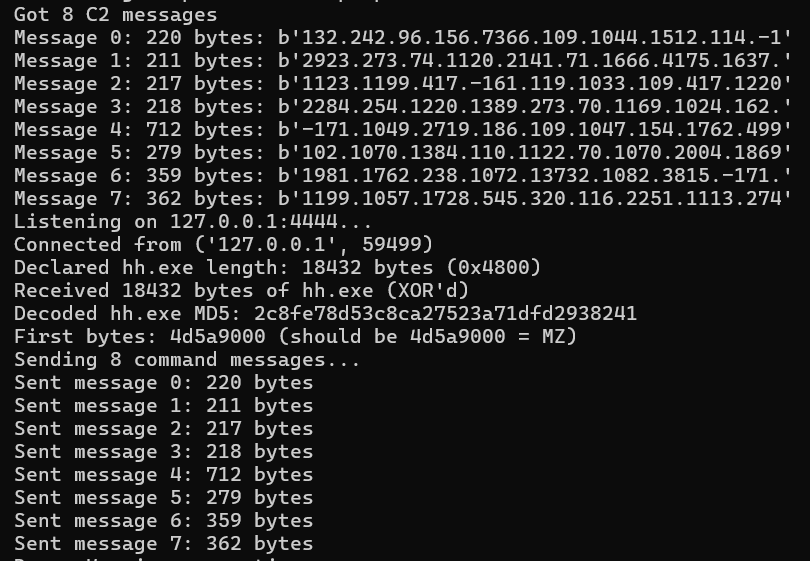
Command executor hit
The malware decoded the first C2 message using the lookup table and called sub_140006720. We hit the BP there. At this point R8 in the hints panel already shows a preview of \r\nWindows IP Configuration\r\n - the output of ipconfig /all being prepared to send back. The right-hand stack/reference panel has the full string.
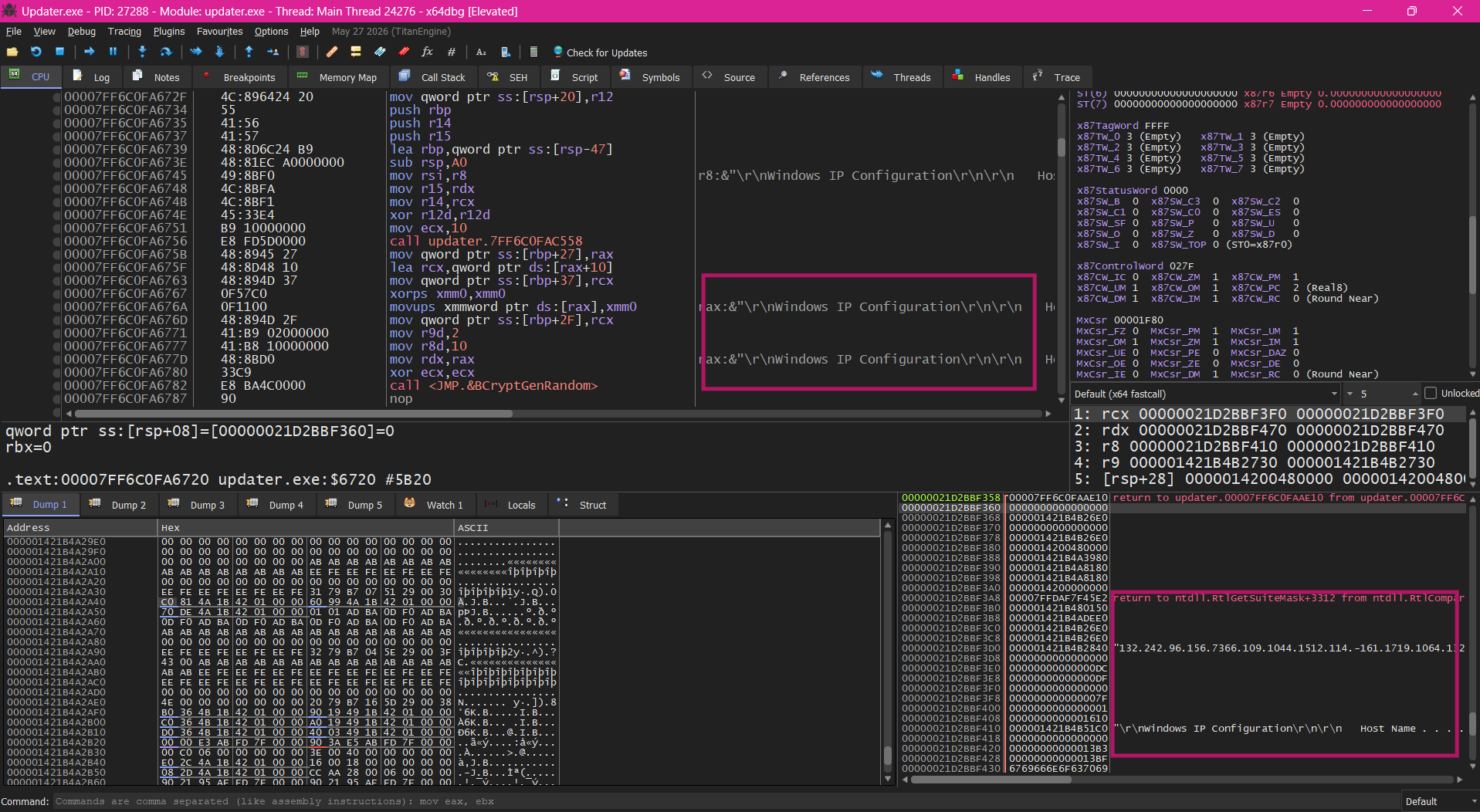
Hmm well if the output was IPconfig thenn first command was ipconfig /all. Its output - hostname DESKTOP-HRP7SJJ, all adapter info - was assembled in memory and sent back to the C2 server.
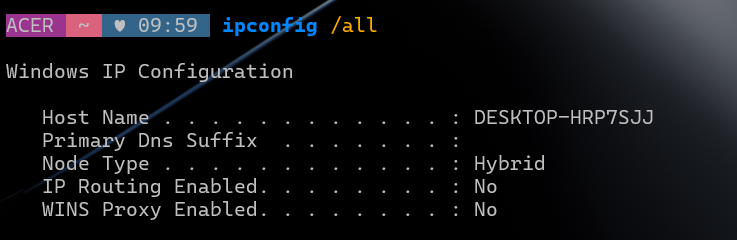
Answer: ipconfig /all
Question 8 - Return result of the whoami command
Answer: desktop-gb98l3m\tsuki
Solution
At the point we'll need to understand the updater malware in deapth Reversing the C2 encoding scheme
After many xrefs and renaming stuff the C2 traffic is not just indexed lookups into hh.exe - the full encoding scheme will needed to be reversed to decrypt
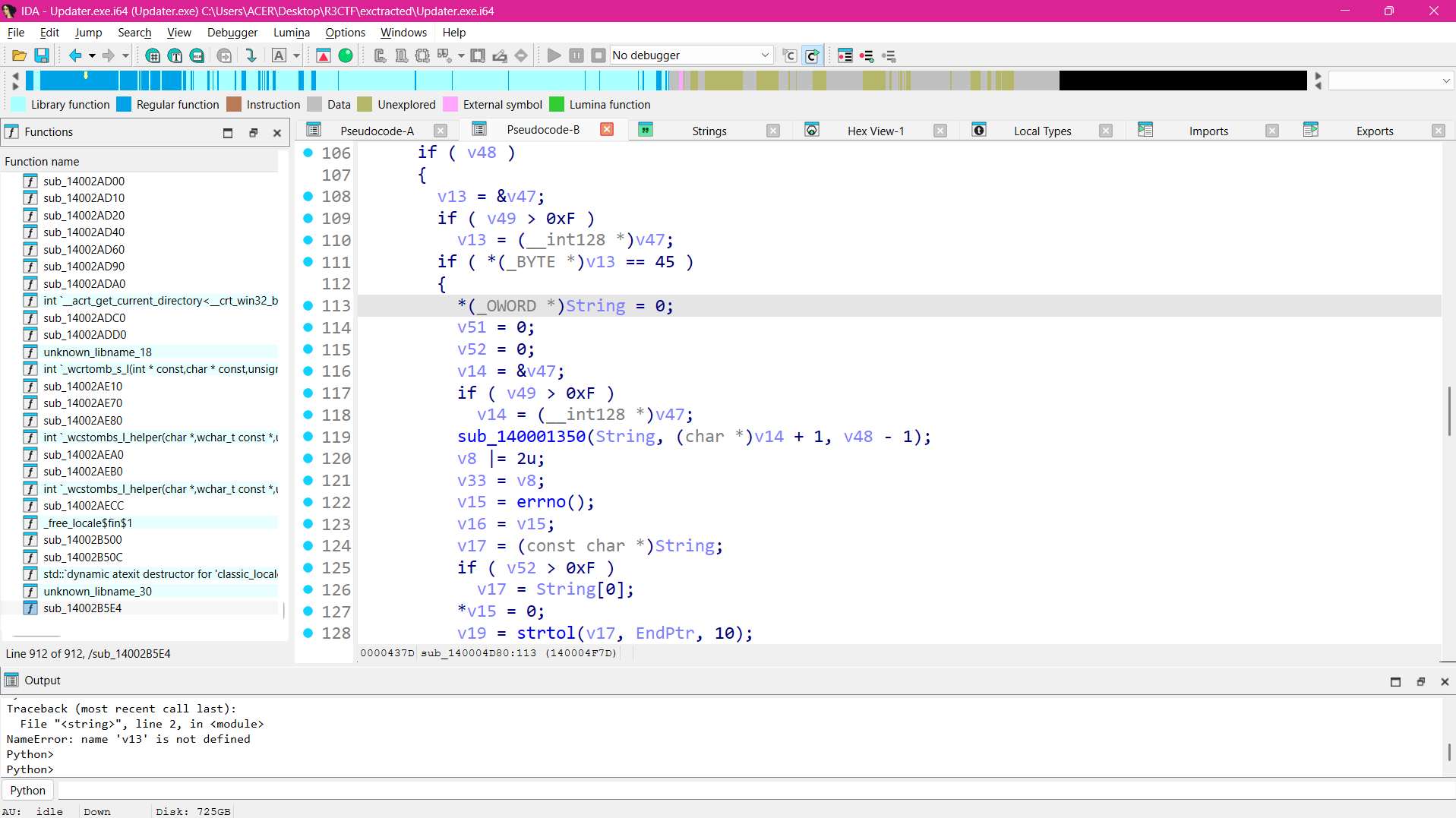
In IDA , sub_140004D80 (the parser called by the C2 decoder) reveals the exact logic. At line 111, it checks whether the first byte of each token equals 45 - the ASCII code for -:
if ( *(_BYTE *)v13 == 45 )   // token starts with '-'
{
    // Negative: strip the '-', parse remaining digits, use that integer directly as the byte value
    v19 = strtol(v17, EndPtr, 10);
    *v21 = v19;
}
else
{
    // Positive: parse as unsigned 64-bit index, walk the lookup tree built from hh.exe,
    // find the node whose key equals this index, and use its stored byte value
    v25 = sub_140015900(v24, &v34, 10);
    // ... tree walk ...
    *v28 = *(_BYTE *)v12;   // byte from hh.exe at that index
}
Soooo the encoding scheme is:
- Positive integer - index into
hh.exe; the byte at that position is the decoded value - Negative integer - the absolute value is the byte directly (e.g.
-161- byte0xa1)
This scheme applies to both C2-victim (commands) and victim-C2 (responses). All traffic is encoded then AES-CBC encrypted, with the decoded byte stream structured as: key (16 bytes) || ciphertext || iv (16 bytes).
Noew we can Decrypt all commands and responses
With the correct scheme, lets extracted all 8 commands from the PCAP:
with open('tsuki_hh.exe', 'rb') as f:
    hh = f.read()

def decode(s):
    out = bytearray()
    for num in s.strip().split('.'):
        n = int(num)
        out.append(-n if n < 0 else hh[n])
    return AES.new(bytes(out[:16]), AES.MODE_CBC, bytes(out[-16:])).decrypt(bytes(out[16:-16]))
Running against the C2-victim messages:

[1] ipconfig /all
[2] whoami
[3] dir
[4] tasklist
[5] REG ADD HKLM\SYSTEM\CurrentControlSet\Control\Terminal" "Server /v fDenyTSConnections /t REG_DWORD /d 00000000 /f
[6] net user aurahack P@ssw0rd /add
[7] net localgroup Administrators aurahack /add
[8] netsh firewall set opmode disable
The same decoder applied to victim-C2 response traffic decrypts the whoami output (response #2):

Tsuki's machine hostname is DESKTOP-GB98L3M and the logged-in user is tsuki.
Answer: desktop-gb98l3m\tsuki
Question 9 - New user created by the attacker
Answer: Username: aurahack / Password: P@ssw0rd
Solution
Well from the decrypted command list we have everything ( Q8, command 6 is):
net user aurahack P@ssw0rd /addThis creates a local Windows user account with username aurahack and password P@ssw0rd.
Answer: aurahack / P@ssw0rd
Question 10 - 7th word of the MetaMask wallet seed phrase
Answer: faint
Solution
After solving Q9, the CTF provided Evidence.zip with password finallyy 18ae3a54-1c1a-4f44-adca-9884acb80d9a. Extracting it is a single file: Cache0000.bin (48 MB).
The RDP8bmp magic header means this as a Windows RDP bitmap cache file - tiles of screen content cached during the attacker's RDP session (which they enabled via the REG ADD ... fDenyTSConnections command in Q7). The thing is these tiles contain fragments of whatever was visible on Tsuki's screen during the RDP session.
PS read for how it works internally: RDP Bitmap Cache - Pieces of the Puzzle (DFIR Spot), RDP Bitmap Cache (DFIR Journal)
We used bmc-tools (ANSSI-FR) to extract and reassemble the tiles into a collage:
python bmc-tools.py -s Cache0000.bin -d bmc_out -b
This produced a 4096 -2944 collage BMP from 2943 cached screen tiles:
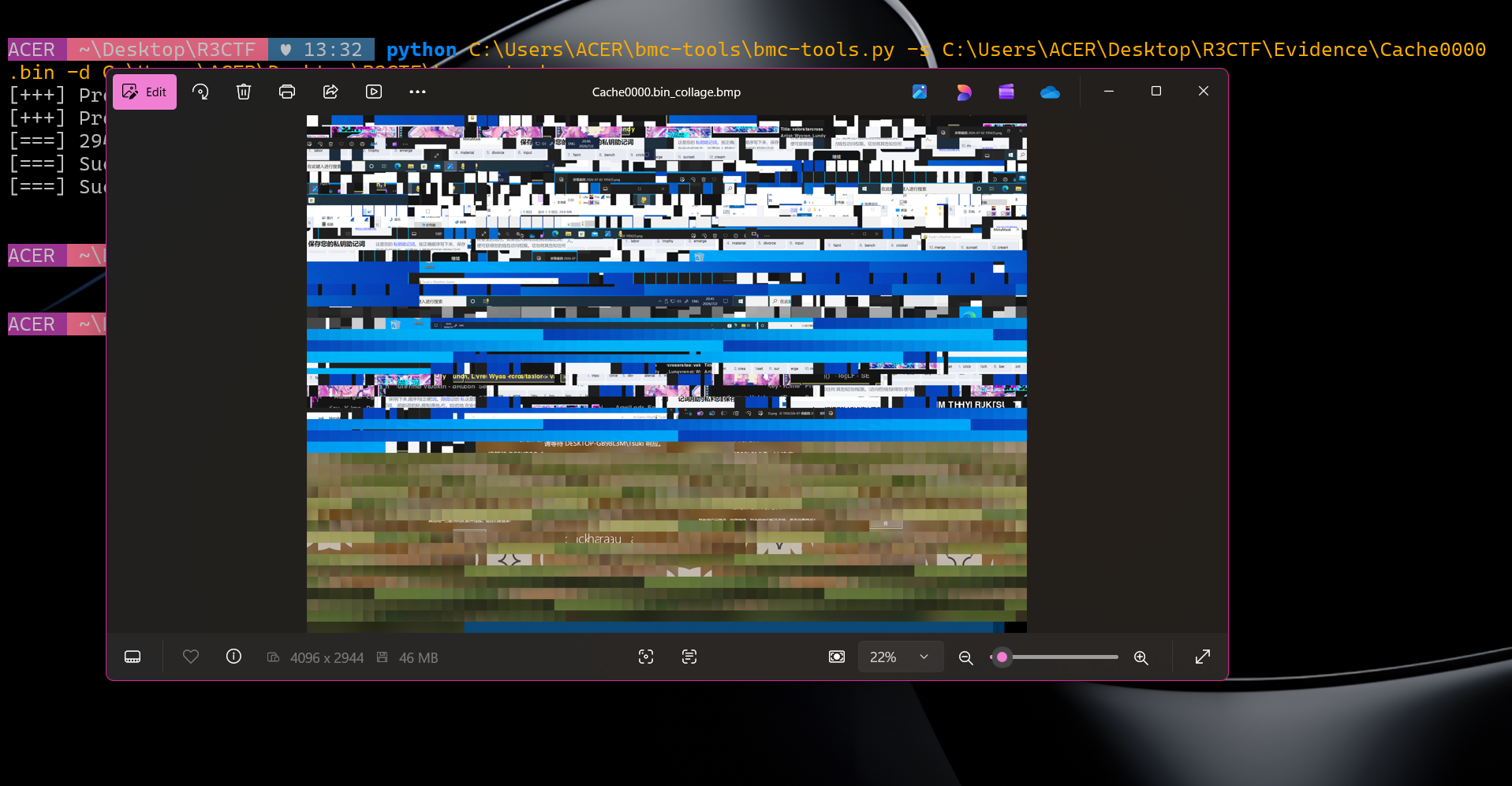
Examining the collage closely, a MetaMask "Save your Secret Recovery Phrase" dialog is visible in the top strip, showing all 12 seed words in numbered order:

1. labor    2. trophy   3. emerge   4. material   5. divorce   6. input
7. faint    8. bench    9. cricket  10. merge     11. sunset   12. cream
The 7th word is faint.
Question 11 - Victim's Ethereum wallet address
Answer: 0x27A2481a2D840C64c1f6a99842E1A63A1586237e
Solution
With all 12 seed words recovered from the RDP bitmap cache, the Ethereum wallet address is deterministically derivable using standard BIP-39/BIP-44 derivation (path m/44'/60'/0'/0/0).
from eth_account import Account

Account.enable_unaudited_hdwallet_features()

mnemonic = "labor trophy emerge material divorce input faint bench cricket merge sunset cream"
acct = Account.from_mnemonic(mnemonic)
print("Ethereum wallet address:", acct.address)
MetaMask generates entropy, maps it to words from a fixed 2048-word list (BIP-39), and derives everything else from that. The imp thing is the same words, same wallet on any decive.
eth_account does all of this in one call,thats also why stealing the seed phrase is game over.
Answer: 0x27A2481a2D840C64c1f6a99842E1A63A1586237e
Flag
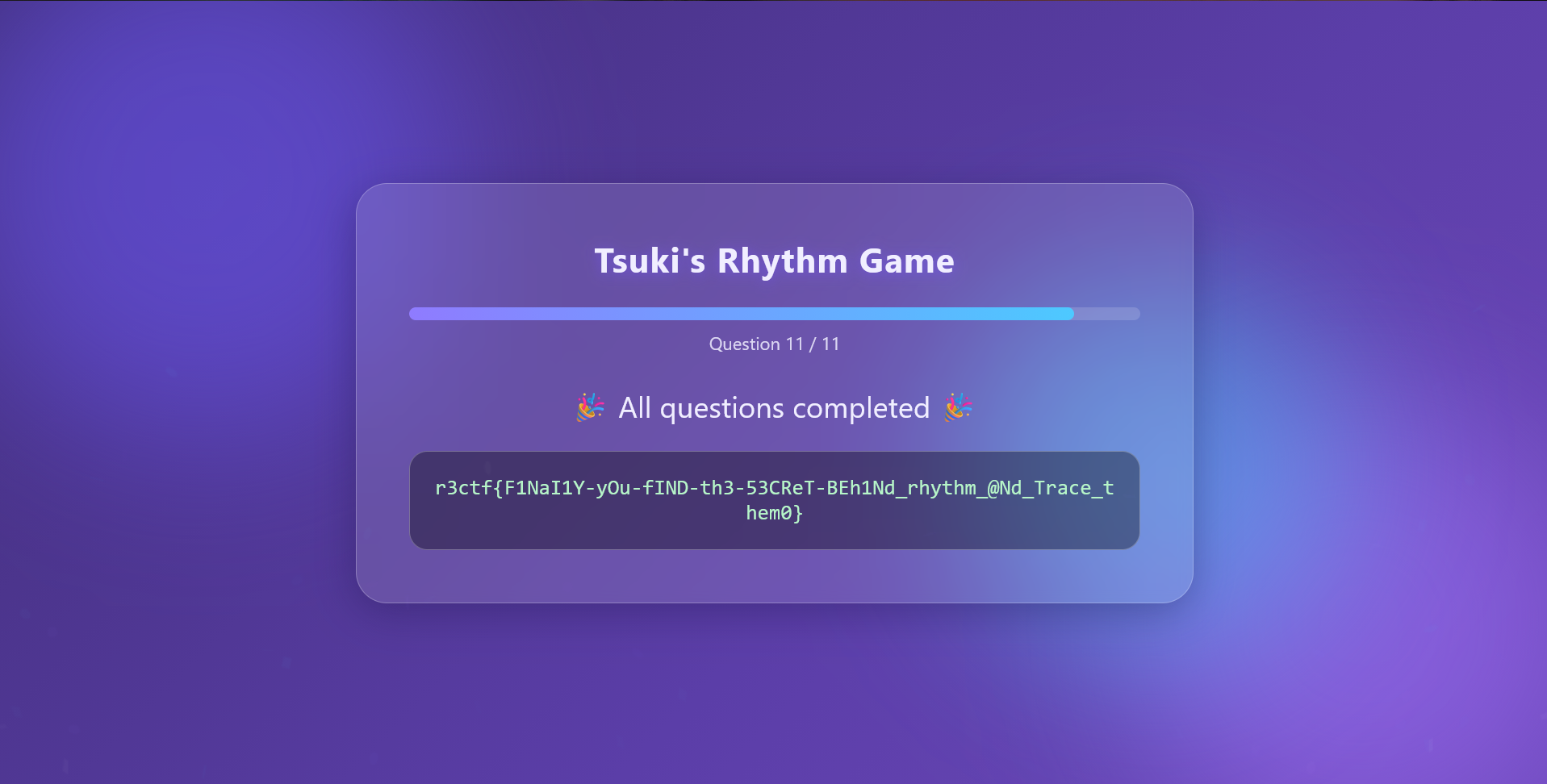
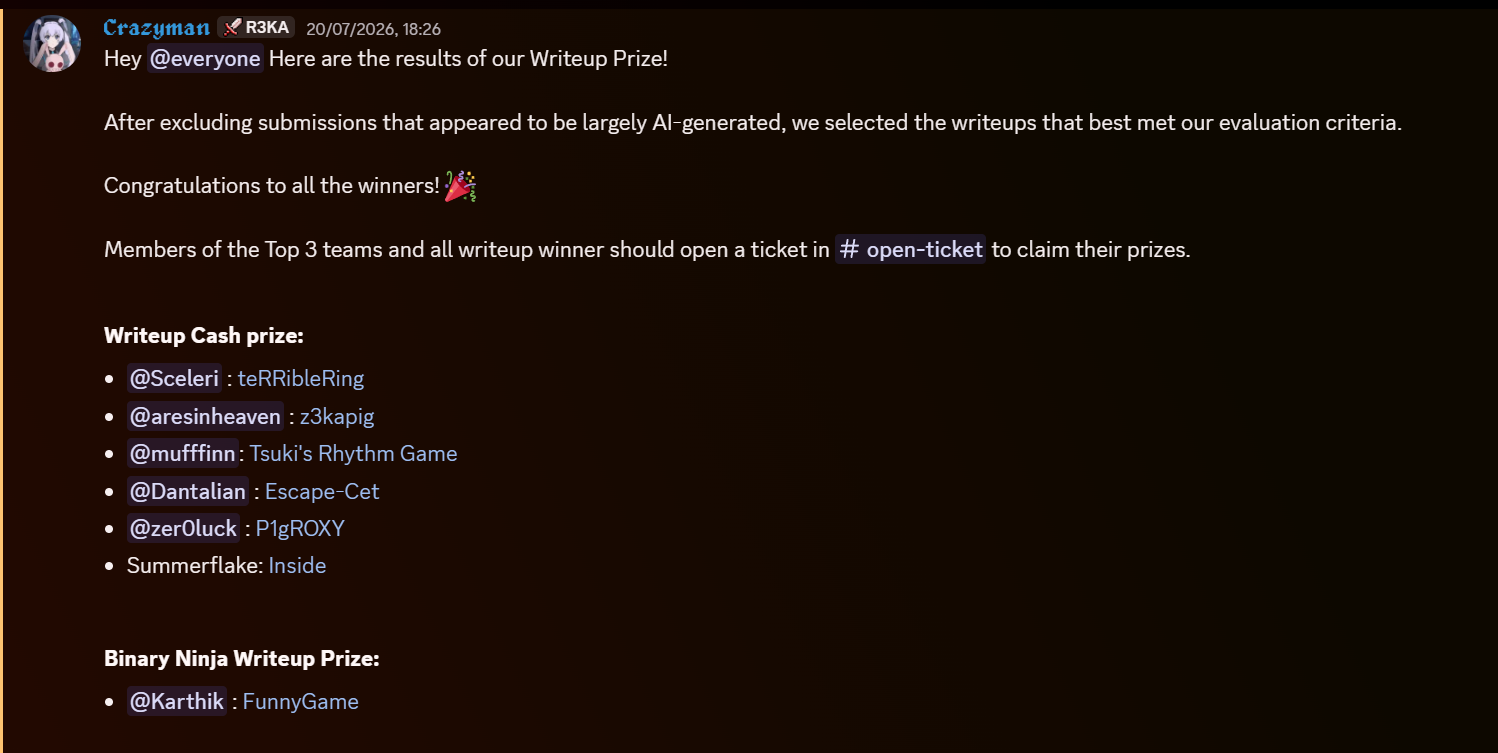
Thank you r3kapig for the $300 prize :)
 Start
Start